Don’t Leave Your Data in the Hands of an MSP Without a Plan!

It’s time to face the facts, cyber attacks are on the rise, and your data is more vulnerable than ever. With this in mind, it’s critical to choose an MSP that takes cybersecurity seriously. But how can you be sure that your MSP is up to the task? The answer is simple: check for Cyber Essentials certification!

Cyber Essentials is a UK government-backed certification that demonstrates a commitment to cybersecurity. It’s the bare minimum that an MSP should have, and yet a recent study showed that only a small percentage of MSPs in the UK have it. Don’t take any chances with your data, make sure your MSP is Cyber Essentials certified.

Think of it this way, would you trust a doctor who didn’t have their medical license? Of course not! So, why trust an MSP with your sensitive data without the necessary security certifications?

In short, make sure your MSP is taking their responsibility seriously. Choose an MSP with Cyber Essentials certification and rest assured that your data is in good hands.

If you follow Microsoft products, then you may know about Microsoft Ignite. Held annually, it generates many exciting updates and announcements in the Microsoft world.

Microsoft held its most recent conference last October. In the rush of the recent holidays, you may have missed some of the highlights. So, we’re bringing them to you now.

One thing you’ll notice is that Microsoft Teams got a lot of love at the event. Microsoft is now describing Teams as “the app at the center of Microsoft 365.” We can see why the company keeps enhancing this virtual workspace. Teams now has over 280 million users. It’s not surprising seeing that Microsoft has introduced over 450 new Teams features. And that’s just in the last year.

We’ll go over some Teams features below, along with other Microsoft App announcements from Ignite. These may give you some ideas for your next digital workflow upgrade.

Teams Premium

There is a new Teams Premium offering from Microsoft that adds a whole new AI component to the platform. This service includes several AI-powered features. They make it seem like you have your own meeting assistant.

Some of the cool features include automatically generating chapters from a Teams meeting. The app also generates personalized highlights for you. This saves you from having to rewatch the meeting later.

If you’re meeting internationally, you can enjoy real-time translations for captions. Meeting guides is another new feature. It sets up your meeting options according to your needs.

360-Degree Intelligent Camera for Teams Meetings

SmartVision 60 is the first 360-degree, center-of-room intelligent camera. It has the ability to track the speaker as they’re moving. The camera is also due to have a people recognition feature coming soon.

Virtual meetings can feel much more like real meetings using SmartVision 60. Instead of just seeing a small video feed of one person, the movement of the camera can capture a whole team.

Cisco is Now a Certified Devices Partner for Teams Rooms

Those that are fans of Cisco meeting products will be pleased to know they now have more options. Microsoft announced that Cisco is now a Teams Room Certified Devices partner. You can now start Teams meetings across all certified Cisco meeting devices.

Microsoft Places

One of the virtual workspace apps to support the new hybrid movement is Microsoft Places. This is a team management app that integrates with the rest of the Microsoft 365 ecosystem.

The office is still around, but for how long? Much of the world had to do things virtually during the pandemic. Many companies and employees found they like it better that way. Seventy-four percent of US companies have or plan to put in place a permanent hybrid work model.

Microsoft Places is one more way Microsoft is leading the hybrid office revolution. Some of the app’s features include:

  • Manage and track where employees are working (at home or in the office)
  • Track whether coworkers are away or available
  • Track physical room use to make strategic decisions

Hours & Location Feature in Outlook & Teams

Another feature announcement related to the hybrid working world is hours and location. This is a new capability added to Teams and Outlook to make it easier to schedule in-person meetings.

It can get tricky to plan in-person meetings when you don’t know who is working at the office and who is remote. If you plan without checking, you’re bound to alienate someone. They won’t be happy if they were planning to work from home that day.

The new hours and location feature allows people to specify where they are working. They can adjust this from hour to hour. It takes the guesswork out of scheduling.

Loop App Private Preview

Another exciting app announcement that Microsoft made was about its Loop app. It stated that Loop entered private preview. This gives some organizations a chance to check it out.

Loop is a collaborative workspace app that helps teams ideate in a virtual space. All data pulled in from Microsoft 365 apps syncs automatically to stay up to date.

Microsoft Clipchamp Video Editor

You may have noticed an unfamiliar app popping up on Windows. Microsoft Clipchamp was formally announced at the Ignite event. It’s a quick and easy video editor for Windows PCs.

Have you ever felt frustrated trying to fix a video and not having the right tool to do it? Then you may want to take a closer look at what Clipchamp has to offer. It looks to have a fairly low learning curve.

Get Help Navigating the Microsoft 365 Universe

Microsoft 365 has come a long way in a short period. There are many different app integrations you can use to power your workflow. But it can get a bit complicated without an expert to help. Give us a call today to schedule a Microsoft consultation.


Featured Image Credit

This Article has been Republished with Permission from .

Cybersecurity insurance is still a pretty new concept for many SMBs. It was initially introduced in the 1990s to provide coverage for large enterprises. It covered things like data processing errors and online media.

Since that time, the policies for this type of liability coverage have changed. Today’s cyber insurance policies cover the typical costs of a data breach. Including remediating a malware infection or compromised account.

Cybersecurity insurance policies will cover the costs for things like:

  • Recovering compromised data
  • Repairing computer systems
  • Notifying customers about a data breach
  • Providing personal identity monitoring
  • IT forensics to investigate the breach
  • Legal expenses
  • Ransomware payments

Data breach volume and costs continue to rise. 2021 set a record for the most recorded data breaches on record. And in the first quarter of 2022, breaches were up 14% over the prior year.

No one is safe. Even small businesses find they are targets. They often have more to lose than larger enterprises as well. About 60% of small businesses close down within 6 months of a cyber incident.

The increase in online danger and rising costs of a breach have led to changes in this type of insurance. The cybersecurity insurance industry is ever evolving. Businesses need to keep up with these trends to ensure they can stay protected.

Here are some of the cyber liability insurance trends you need to know about.

Demand is Going Up

The average cost of a data breach is currently $4.35 million (global average). In the U.S., it’s more than double that, at $9.44 million. As these costs continue to balloon, so does the demand for cybersecurity insurance.

Companies of all types are realizing that cyber insurance is critical. It’s as important as their business liability insurance. Without that protection, they can easily go under in the case of a single data breach.

With demand increasing, look for more availability of cybersecurity insurance. This also means more policy options, which is good for those seeking coverage.

Premiums are Increasing

With the increase in cyberattacks has come an increase in insurance payouts. Insurance companies are increasing premiums to keep up. In 2021, cyber insurance premiums rose by a staggering 74%.

The costs from lawsuits, ransomware payouts, and other remediation have driven this increase. Insurance carriers aren’t willing to lose money on cybersecurity policies. Thus, those policies are getting more expensive. This is at the same time as they are more necessary.

Certain Coverages are Being Dropped

Certain types of coverage are getting more difficult to find. For example, some insurance carriers are dropping coverage for “nation-state” attacks. These are attacks that come from a government.

Many governments have ties to known hacking groups. So, a ransomware attack that hits consumers and businesses can very well be in this category.

In 2021, 21% of nation-state attacks targeted consumers, and 79% targeted enterprises. So, if you see that an insurance policy excludes these types of attacks, be very wary.

Another type of attack payout that is being dropped from some policies is ransomware. Between Q1 and Q2 of 2022, ransomware attacks increased by 24%.

Insurance carriers are tired of unsecured clients relying on them to pay the ransom. So many are excluding ransomware payouts from policies. This puts a bigger burden on organizations. They need to ensure their backup and recovery strategy is well planned.

It’s Harder to Qualify

Just because you want cybersecurity insurance, doesn’t mean you’ll qualify for it. Qualifications are becoming stiffer. Insurance carriers aren’t willing to take chances. Especially on companies with poor cyber hygiene.

Some of the factors that insurance carriers look at include:

  • Network security
  • Use of things like multi-factor authentication
  • BYOD and device security policies
  • Advanced threat protection
  • Automated security processes
  • Backup and recovery strategy
  • Administrative access to systems
  • Anti-phishing tactics
  • Employee security training

You’ll often need to fill out a lengthy questionnaire when applying for insurance. This includes several questions about your cybersecurity situation. It’s a good idea to have your IT provider help you with this.

This can seem like a lot of work that you have to do to qualify for cyber insurance. As you review the questions, your IT partner can identify security enhancements. Just like other forms of insurance, if you take steps to reduce risk, it can often reduce your premiums.

So, it pays to do a cybersecurity review before applying for cyber insurance. You can save yourself time and money. It can also fortify your defenses against cyberattacks.

Need Help Making Sense of Cybersecurity Policies?

Cybersecurity coverage and insurance applications can be complex. If you answer wrong on a question, it can mean paying hundreds more in premiums than you should.

If you’re considering cybersecurity insurance, don’t go it alone. Give us a call and schedule a consultation. We can explain the policy details and provide guidance.


Featured Image Credit

This Article has been Republished with Permission from .

The new year has just begun and it’s a time of renewal as we plan for the possibilities to come in 2023. It’s also a time when you need to plan for resiliency in the face of ever-present cyberattacks.

Sixty-eight percent of surveyed business leaders feel that cybersecurity risks are getting worse. They have a good reason. Attacks continue to get more sophisticated. They are also often perpetrated by large criminal organizations. These criminal groups treat these attacks like a business.

In 2021, the average number of global cyberattacks increased by 15.1%.

To protect your business in the coming year, it’s important to watch the attack trends. What new methods are hackers using? What types of attacks are increasing in volume? Knowing these things is important. It helps you better update your IT security to mitigate the risk of a data breach or malware infection.

We’ve pulled out the security crystal ball for the upcoming year. And we’ve researched what cybersecurity experts are expecting. Here are the attack trends that you need to watch out for.

Attacks on 5G Devices

The world has been buzzing about 5G for a few years. It is finally beginning to fulfill the promise of lightning-fast internet. As providers build out the infrastructure, you can expect this to be a high-attack area.

Hackers are looking to take advantage of the 5G hardware used for routers, mobile devices, and PCs. Anytime you have a new technology like this, it’s bound to have some code vulnerabilities. This is exactly what hackers are looking to exploit.

You can prepare by being aware of the firmware security in the devices you buy. This is especially true for those enabled for 5G. Some manufacturers will build better firmware security into their designs than others. Make sure to ask about this when purchasing new devices.

One-time Password (OTP) Bypass

This alarming new trend is designed to get past one of the best forms of account security. Multi-factor authentication (MFA) is well-known as very effective at preventing fraudulent sign-in attempts. It can stop account takeovers even in cases where the criminal has the user’s password.

There are a few different ways that hackers try to bypass MFA. These include:

  • Reusing a token: Gaining access to a recent user OTP and trying to reuse it
  • Sharing unused tokens: The hacker uses their own account to get an OTP. Then attempts to use that OTP on a different account.
  • Leaked token: Using an OTP token leaked through a web application.
  • Password reset function: A hacker uses phishing to fool the user into resetting a password. They then trick them into handing over their OTP via text or email.

Attacks Surrounding World Events

During the pandemic, the cyberattack volume increased by approximately 600%. Large criminal hacking groups have realized that world events and disasters are lucrative.

They launch phishing campaigns for world events. Attacks come for everything from the latest hurricane or typhoon to the war in Ukraine. Unsuspecting people often fall for these scams. This is because they are often distracted by the crisis.

People need to be especially mindful of scams surrounding events like these. They will often use social engineering tactics, such as sad photos, to play on the emotions.

Smishing & Mobile Device Attacks

Mobile devices go with us just about everywhere these days. This direct connection to a potential victim is not lost on cybercriminals. Look for more mobile device-based attacks, including SMS-based phishing (“smishing”).

Many people aren’t expecting to receive fake messages to their personal numbers. But cell numbers are no longer as private as they once were. Hackers can buy lists of them online. They then craft convincing fake texts that look like shipping notices or receipts. One wrong click is all it takes for an account or data breach.

Mobile malware is also on the rise. During the first few months of 2022, malware targeted to mobile devices rose by 500%. It’s important to ensure that you have good mobile anti-malware. As well as other protections on your devices, such as a DNS filter.

Elevated Phishing Using AI & Machine Learning

These days, phishing emails are not so easy to spot. It used to be that they nearly always had spelling errors or grainy images. While some still do, most don’t.

Criminal groups elevate today’s phishing using AI and machine learning. Not only will it look identical to a real brand’s emails, but it will also come personalized. Hackers use these tactics to capture more victims. They also allow hackers to send out more targeted phishing messages in less time than in years past.

Schedule a Cybersecurity Check-Up Today

Is your business prepared for the cyber threats coming in 2022? Don’t wait to find out the hard way! Give us a call and schedule a cybersecurity check-up to stay one step ahead of the digital criminals.


Featured Image Credit

This Article has been Republished with Permission from .

The global home security market has been growing by leaps and bounds. By 2026, experts expect the market to expand at a rate of 20.1%. This is on top of an expected increase of 21.6% from 2021 to 2022.

From Ring doorbell cams to entire home security systems, consumers want these solutions. Watching your front door from afar has never been so easy. With cloud-based video streams, homeowners can view any part of their home.

Sharing doorbell camera shots on neighborhood social media groups is now common. These home security systems also provide peace of mind at a wallet-friendly cost.

But don’t let the ease of setup fool you. Home security cameras can open your family up to risks if you don’t take precautions. Often, people are so excited to see what they can do, they don’t stop to think about device security.

There are horror stories online about hacked video cameras. This includes strangers saying disturbing things through those cameras to children.

Additionally, in 2019, Ring suffered a data breach. That breach exposed the personal data of over 3,000 Ring users. This included usernames and passwords.

It’s enough to make you reconsider your decision to add extra security. But don’t let those incidents scare you off. You can properly secure a home video camera system to ensure it’s not breached.

Here are some of the things you should do for a safe home security setup.

Make Sure Your Router is Secure

You access an IP security camera via the internet. Any commands going to the system or footage coming from it go through your router. So, you need to make sure that your router is properly secured.

Hackers breach routers so they can get to the devices connected to that network. Ensure your router security protocol is no lower than WPA2. The next generation, WPA3, is even better. These protocols govern the protection of data transmitted through the wireless network.

Give the router a strong password that is at least 12 characters long. Software can crack a password of only 8 standard characters instantly. But a 12-character password with at least one upper case letter, number, and symbol takes 34,000 years.

Change the Default Username & Password

You also need a strong password for your security system’s admin account. You should also change the default device and username. Hackers have lists of all these device defaults and use them to break into these systems.

Changing the default username and password for the device should be one of the first things you do. Otherwise, it could be mere minutes after you connect to the internet that you’re hacked.

Ensure the System Uses SSL/TLS Or Other Encryption

You don’t want the footage from your cameras transmitted for anyone to grab and watch. Make sure the security system you choose notes SSL/TLS. Or another standard encryption.

This ensures that the data cannot be intercepted and accessed. SSL is short for Secure Sockets Layer, and TLS is short for Transport Layer Security. Without a form of encryption, a hacker can easily breach your device.

Keep the Software Updated

If your security system has an automatic update feature, turn that on. Unfortunately, many users don’t think about updating their device software. This leaves it more vulnerable to a hack.

Updates often include important security fixes for found vulnerabilities. You want to make sure updates install promptly. That’s why automating this is best.

Consider Access Levels for Multiple Users

Do you have several family members accessing your cloud-based security device? If so, set up some access levels. Not everyone needs to be at an administrator level.

Hackers love it when they can breach the login of an admin user for an account. This gives them more privileges, like changing settings. Giving lower-level privileges, such as “view only,” to most family members improves security.

Enable Camera Security Features

There will be various security features that are available with your system. Manufacturers often do not enable all security settings by default. The user must turn all or some of them on.

If you’re unsure of what settings should be on or off, we’ll be happy to help. Some home security systems have generous sharing options. This can be an invitation for hackers. You want to restrict these as much as possible.

Make Sure Your Mobile Device is Secure

Most people access their security cam through their smartphone. Make sure that you secure yours and keep it updated with the latest operating system. Hackers can gain access to a security system through a device with weak safeguards.

Add things like:

  • Mobile anti-malware
  • DNS filtering
  • Screen lock
  • Automated updating

Looking for Help Protecting Your Cloud Security System?

Give us a call and schedule a visit. We’ll be happy to help you ensure your security system is set up with best practices.


Featured Image Credit

This Article has been Republished with Permission from .

You Won’t Believe the Surprising Benefits of an IT Audit – Don’t Neglect Your Business’s Technology Health Any Longer”

Let me ask you a question: How do you feel about paperwork? How about bureaucracy? And regulations? I bet you’re just thrilled at the thought, right? Well, let me introduce you to the IT audit: The ultimate trifecta of paperwork, bureaucracy, and regulations. Are you excited yet?

You see, in today’s digital age, technology is like a wild animal. It’s powerful, it’s exciting, but it’s also dangerous. And just like a wild animal, you need to keep it in check. But instead of a leash, we use something called an IT audit. It’s like a straight jacket for your technology. It’s there to keep everything under control and make sure nothing gets out of hand.

But here’s the thing, conducting an IT audit is like going to the dentist: it’s not fun, it’s not exciting, but it’s necessary. And just like going to the dentist, it’s better to have a professional do it, rather than trying to do it yourself. Because let’s face it, when it comes to IT, most of us are just winging it. It’s like trying to fix a car engine with a hammer and a pair of pliers. Sure, you might get the job done, but it’s not going to be pretty and it’s not going to last.

And let’s not forget about the importance of compliance. Oh, the joy of regulations and paperwork. In the UK, we have strict regulations when it comes to data protection and privacy. And if you’re not regularly checking in on your IT systems, you’re putting your company at risk of non-compliance. It’s like playing a game of “Red Light, Green Light” with the government, and if you’re not paying attention, you’re going to get hit with a huge fine.

But perhaps the most important aspect of an IT audit is the peace of mind it brings. When you know that your IT systems are healthy and compliant, you can focus on what really matters: growing your business. You can sleep soundly at night knowing that your data is secure, and that you’re not at risk of a damaging data breach. But let’s be real, no one actually sleeps soundly while thinking about IT audits.

So, I urge you all to consider the importance of an annual IT audit conducted by a third party. Don’t wait until it’s too late, until you’re dealing with a data breach or a compliance violation. Take the proactive approach, and schedule an IT audit today. Or don’t, and live on the edge, just remember, it’s not a matter of if, but when something goes wrong.

In conclusion, the IT audit may not be the most exciting thing in the world, but it’s a necessary evil. It’s like eating your vegetables, you might not like it, but it’s good for you. It ensures the integrity of your technology, the security of your data, the compliance with regulations and brings peace of mind. Don’t wait until it’s too late, schedule an annual IT audit conducted by a third party expert today and keep your business running smoothly. And remember, just like spinach, it might not be the most thrilling thing, but it’s essential for a healthy diet.

You often hear the words “digital transformation” and “collaboration.” But what do they actually mean? What do they mean for the day-to-day of running your business?

Collaboration can’t happen without shared goals. When departments are siloed and unconnected, priorities can conflict. People are doing their best but may not be moving in the same direction.

Digital transformation is simply the use of technology to better reach business goals. This encompasses moving from analog ways of doing things. Transitioning to tools that are more automated and connected.

Microsoft has been at the forefront of digital transformation and collaboration. Its Viva platform drives an improved employee experience. It does this by use of AI, automation, cloud connectivity, and more.

In this article, you’ll get an overview of Microsoft Viva. Then, we’ll dive into one of the newest Viva offerings, Viva Goals. We’ll explore what it does and how it can help your company meet its targets.

What Is Microsoft Viva?

Microsoft Viva is a line of employee experience applications. These connect to the Microsoft 365 platform, and especially Microsoft Teams. The apps act as add-ons that can build on your organization’s digital capabilities.

There are currently seven apps within the Microsoft Viva line:

  • Viva Topics: Allows organizations to harness knowledge and experience. It serves up relevant topics from the company knowledge base from keywords.
  • Viva Connections: Gives employees a personalized and connected newsfeed. The company newsfeed serves up important news, conversations, and tools.
  • Viva Learning: Consolidates employee training apps. Makes it easy for employees to gain new skills from inside the MS Teams application.
  • Viva Insights: Improves employee well-being and corporate culture. Uses data-driven insights to provide productivity and well-being recommendations.
  • Viva Sales: Reduces the data input needed from salespeople. Serves up helpful lead interaction recommendations.
  • Viva Engage: Cultivates personal networks and community. Fosters engagement and knowledge sharing.
  • Viva Goals: Enables clarity and alignment of corporate goals.

The Viva line expands what businesses may traditionally see as “software.” It creates a connection between Microsoft Office and M365 apps. It also focuses on the people, rather than the tool. Microsoft designed Viva applications to use AI. This makes work easier and gives visibility into actionable data points.

What is Viva Goals?

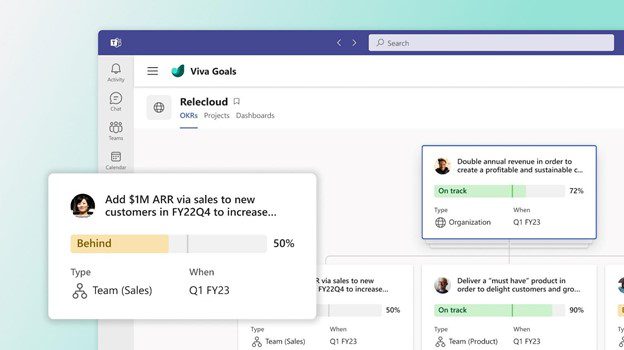
Viva Goals is one of the newest Viva applications from Microsoft. It connects teams so they’re moving toward a shared set of goals. Employees align, whether someone works in the accounting department or customer support.

Business leaders can look at Viva Goals as a way to solidify company objectives. They can then tie these objectives to meaningful targets for each department.

Viva Goals
Image from Microsoft

For example, say you have a corporate target to provide exceptional customer support. This goal by itself is generic. It doesn’t connect to what teams need to do to make it happen.

In Viva Goals, that target can have directives for various teams. Such as customer support reducing ticket resolution by 8 hours. This brings goals to a meaningful level and allows organizations to track progress.

Here are the key value-adds of using Viva Goals.

Aligns Your Team to the Same Goals

Viva Goals puts company goals and targets in a tangible form. There is a definition of success for teams and individuals. Work outcomes are directly connected to company-wide objectives.

Everyone is on the same page, rather than departments pursuing different targets. With alignment, companies can more easily reach their goals.

Maintains Focus on Goals

Viva connects to other M365 apps, making it easier to gather data insights. These insights help leaders more easily see goal progress.

Employees stay focused on goals. This is because goals connect to their daily work targets. Rather than being something they hear at a company event, goals get infused into the workflow.

Focus on Goals
Image from Microsoft

Integration with Teams & M365

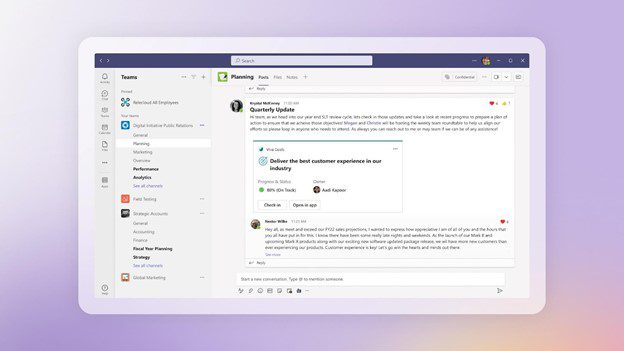
The integration with Teams keeps goals front and center. Employees get recognized for meeting targets and helping the company achieve its goals. This keeps everyone engaged and moving together.

Progress towards goals isn’t kept on a spreadsheet on someone’s cloud drive. Instead, stats on goal achievement live in tools used daily. When goals remain visible, organizations have a better chance to achieve them.

How Do You Get Viva Goals?

If you want to subscribe to Viva Goals as an add-on to your M365 plan, it is currently $6.00/user/month.

For the entire suite of Viva applications, the current price is $9.00/user/month.

Questions About Microsoft 365 or Viva Goals?

Digital transformation with tools like Microsoft Viva is a necessity if you want to keep up. Old ways of doing things are giving way to the cloud, AI, and machine learning. We can help you navigate that territory. Give us a call and schedule a consultation to learn more.


Featured Image Credit

This Article has been Republished with Permission from .

Don’t Make Excuses! This is why Small UK Businesses Should Get Cyber Essentials Certified

As a small business owner in the UK, you’re probably aware of the increasing risk of cyber attacks. However, you may also have some concerns and objections about getting Cyber Essentials certified. It’s understandable that you may have some reservations, but it’s important to consider the many benefits that certification can bring to your business. In this blog post, we’ll counter some of the common excuses small UK businesses may have against getting Cyber Essentials certified, and highlight the benefits of doing so.

EXCUSE 1: “I don’t have the budget for it.”

One of the most common objections small businesses have about getting Cyber Essentials certified is that it’s expensive. However, this is not the case. The certification process is relatively affordable and cost-effective when compared to the potential cost of a cyber attack. In fact, according to the UK government’s Cyber Security Breaches Survey, the average cost of a cyber attack to a small business is £3,000. Implementing the controls outlined in the Cyber Essentials scheme can help to prevent such attacks, saving your business money in the long run.

EXCUSE 2: “I don’t have the time for it.”

Another common objection small businesses have is that the certification process is time-consuming. While it’s true that the process does require some effort, it’s not as onerous as you might think. A reputable and experienced provider like Equate Group can help you navigate the process of implementing Cyber Essentials, making it as smooth and efficient as possible. Furthermore, the certification process is a one-time effort that will provide ongoing protection for your business.

EXCUSE 3: “I don’t think my business is at risk.”

Some small business owners believe that their business is too small to be targeted by cybercriminals. However, this is not the case. Small businesses are a prime target for cyber attacks, as they often have fewer resources and less robust security systems in place than larger companies. Implementing the controls outlined in the Cyber Essentials scheme can help to protect your business from a wide range of common cyber threats, regardless of its size.

EXCUSE 4: “I don’t know where to start.”

Finally, some small business owners may feel overwhelmed by the prospect of getting Cyber Essentials certified, as they don’t know where to start. However, this doesn’t have to be the case. A reputable and experienced provider like Equate Group can help you navigate the process of implementing Cyber Essentials and achieving certification, from assessing your current security posture to providing ongoing support and maintenance.

Getting Cyber Essentials certified must be an essential step that any small business in the UK should take to protect themselves from cyber threats. The benefits of certification are numerous, including protecting against common cyber threats, demonstrating a commitment to cyber security, improving reputation, and increasing chances of winning contracts. With the help of a reputable and experienced provider like Equate Group, small businesses can navigate the process of implementing Cyber Essentials with ease, and achieve certification that will provide ongoing protection for their business.

10 reasons why all UK SMBs should be Cyber Essentials certified.

Small businesses in the UK are facing an increased risk of falling victim to cyber-attacks. As a result, it’s more important than ever for small businesses to take cybersecurity seriously. One effective solution is the UK government-backed scheme, Cyber Essentials. It is designed to be easy to implement and provides a set of basic but essential controls to help small businesses protect themselves against common cyber threats. By getting Cyber Essentials certified, small businesses can significantly reduce their risk of falling victim to cyber-attacks, and also gain other benefits that can help with the growth and continuity of their business.

Here are ten reasons why your UK business should get Cyber Essentials certified:

  1. Protects against common cyber threats: As the name suggests, Cyber Essentials provide a set of basic but essential controls that help protect against common cyber threats. This includes security measures for firewalls, internet gateways, access control, malware protection, and patch management.
  2. Cost-effective solution: Implementing cyber essentials is a cost-effective solution for small businesses to reduce their risk of falling victim to cyber-attacks significantly.
  3. Demonstrates commitment to cybersecurity: By getting cyber essentials certified, businesses can demonstrate to their customers, partners, and suppliers that they take cybersecurity seriously.
  4. Increases chances of winning contracts: Many large companies now require their suppliers to be cyber essentials certified, so having cyber essentials certification can increase a business’s chances of being selected as a supplier.
  5. Improves reputation: Cyber essentials certification can improve a business’s reputation by showing that they are committed to protecting its customers’ data and information.
  6. Provides peace of mind: Cyber Essentials can provide peace of mind for business owners, knowing they have taken steps to protect themselves from cyber threats.
  7. Provides a competitive edge: By being cyber essentials certified, a business can gain a competitive edge in the marketplace by showing that they take cybersecurity seriously.
  8. Increases credibility: Cyber Essentials certification demonstrates to customers, partners, and suppliers that a business is credible and trustworthy.
  9. Meets regulatory requirements: Cyber Essentials certification can help businesses meet regulatory requirements, such as the General Data Protection Regulation (GDPR).
  10. Easily Implemented: Cyber Essentials are easy to implement, so small businesses can quickly and efficiently take steps to protect themselves from cyber threats.

In conclusion, implementing cyber essentials is a vital step that small businesses in the UK should take to protect themselves from cyber threats. The benefits of getting cyber essentials certified are numerous, including protecting against common cyber threats, demonstrating a commitment to cyber security, improving reputation, increasing chances of winning contracts and being easily implementable.

Achieving cyber essentials certification can be challenging for small businesses due to their limited resources and expertise. However, with the help of a reputable and experienced provider like Equate Group, small businesses can easily navigate the process of implementing cyber essentials.

Equate Group’s team of experts can help with everything from assessing a business’s current security posture to implementing the necessary controls and achieving certification.

If you are a small business owner looking to protect your business from cyber threats and gain a competitive edge in the marketplace, don’t hesitate to contact Equate Group to help achieve cyber essentials certification.

The Importance of Cyber Essentials for Small Businesses: A Look at the Statistics
loudspeaker icon

Cybersecurity is a critical concern for small businesses in the United Kingdom. With over 5.7 million small and medium-sized enterprises (SMEs) operating in the country, these businesses play a vital role in the economy. Unfortunately, small businesses are at a higher risk of falling victim to cyber-attacks. In fact, according to the UK government’s Cyber Security Breaches Survey, an alarming 43% of cyber-attacks target small businesses.

One of the reasons for this increased risk is that small businesses often need more resources and more robust security systems compared to larger companies. This makes them an attractive target for cybercriminals, who can exploit vulnerabilities in their systems to gain access to sensitive data or disrupt operations. The solution to this problem is cyber essential. This UK government-backed scheme provides a set of basic but essential controls to help small businesses protect themselves against common cyber threats.

The National Cyber Security Centre (NCSC) oversees the implementation of cyber essentials, which covers five key areas: boundary firewalls and internet gateways, secure configuration, access control, malware protection, and patch management. By implementing cyber essentials, small businesses can significantly reduce their risk of falling victim to cyber-attacks by up to 80%. Additionally, compliance with cyber essentials can provide small businesses with a competitive edge in the marketplace, as many large companies now require their suppliers to be Cyber Essentials certified as a minimum requirement for doing business with them.

Cyber essentials certification is crucial not only for the protection of small businesses but also the growth and continuity of their business. By implementing cyber essentials, small businesses can demonstrate that they take cyber security seriously, which is essential in today’s digital age.

In addition to protecting small businesses from cyber threats, cyber essentials can also have other benefits. For example, by implementing cyber essentials, small businesses can increase their chances of being selected as suppliers for larger companies.

It’s more important than ever for small businesses in the UK to take cybersecurity seriously. The cyber threat landscape is constantly evolving, and small businesses need to stay ahead of the curve by implementing cyber essentials. By taking this crucial step, small businesses can secure the growth and continuity of their business, as well as protect themselves from common cyber threats.